
HELLO TO A RIVER
The River Wye receives Rights of Nature Designation
Written by Paul John Roach
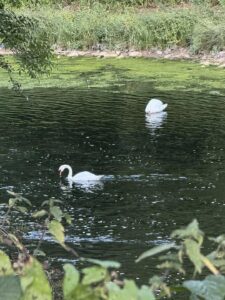
The River Wye is one of the UK’s most beautiful and iconic rivers. It rises in the mountains of mid Wales, flows down through the border country between England and Wales before entering a long, wooded gorge that takes it to its confluence with the River Severn below the old market town of Chepstow with its Norman castle rising dramatically from the cliffs above the river.
The Wye and its landscape were made famous by Romantic writers and poets in the 18th century, notably by William Wordsworth who immortalized the place in his poem of praise to wild Nature and mystical presence commonly called Tintern Abbey.
I have long had an affinity for the Wye and its surrounding landscapes-The Forest of Dean, The Black Mountains and the rich pastureland and orchards of Herefordshire.
I first visited as a child and fell in love with its unspoiled beauty, seemingly endless forests,old castles,abbey, ancient earthworks, dramatic views and the Wye’s aura of being one of Britain’s most pristine rivers.
My parents waxed lyrical about the salmon that thrived there and trips from my home in Cardiff to Tintern Abbey became a favorite outing.
I remember cycling 80 miles one summer’s day to the Wye gorge and back as a boy of 16. I called my mother at work from a phone box halfway, saying, “Guess where I am, mum?”
I’ve taken all the important people in my life: girlfriends,wife, family, to the Wye, and recommended it to many others. Only last year Wendy and I spent our vacation at various parts of the Wye: in a 17th century cottage in deep woods below Monmouth and in a cabin on the banks of the river above the town of Hay on Wye, famous as the book capital of the UK.
On the left side of the Wye gorge is a plateau that provides extensive views of the rolling landscape of Monmouthshire and the brooding blue black of the Black Mountains in the Brecon Beacons National park in the distance.
Here is the village of Trellech with its ancient church and even more ancient standing stones. Step through a gate in the lane and you come to a holy well surrounded by trees and bushes and birdsong. It has been venerated since pagan times and is known as The Virtuous Well. It’s good to take a sip of water there, and, if you are so inclined, to leave an item, a handkerchief or such, attached to a branch as a token to invite the spirit of healing and wholeness.
On the right side of the river is the ancient Forest of Dean with its own distinctive feel and culture, a mix of extensive woodland, laws guarding grazing rights, and the villages and healed over landscapes of former coal and iron workings. Recently wild pigs have colonized the forest and the whole place has a feral atmosphere.
On the northern flank of the Dean is Symond’s Yat and the Yat Rock with its absurdly picturesque views and peregrine falcons patrolling the limestone cliffs above the river.
In recent years the pristine and unspoiled has been wrenched from descriptions of the river itself. The increasing industrializing of agriculture with its over reliance on inorganic fertilizers, together with run off from the battery chicken farms that dominate parts of the landscape and the inadvisible discharge of human sewage has resulted in a severely polluted river. Algae blooms, unsafe conditions for swimming and a 90% fall in salmon stocks are just three indicators of a sick river.
For several years conservationists and lovers of the Wye have advocated for restoration. Authorities have offered tentative support, (conservation laws are already in place), but little of substance has been done.
Finally, in May 2026, a major shift has happened. The River Wye has become the first river in the UK to be given cross border rights as a living ecosystem throughout its entire length.
The shift and the designation is important because it is an acknowledgement, through a legal charter, that the river and its environment is not merely a resource to be utilized but a living entity with a right to perform its natural functions and to be free from pollution.
It is the beginning of a consciousness change that affirms the Rights of Nature to be as important as the Rights of Humanity.
This charter has been endorsed by county councils,The National Park Authority,other government bodies, as well as by conservation groups and activists.
This charter follows other pioneering initiatives worldwide including protection in Equador in 2008, New Zealand in 2017, India,and also the US, where First Nation groups have spearheaded shift.
What changes will it herald? We don’t know yet. It can help to strengthen legal challenges to pollution and other abuses.Perhaps the broad support from Nature advocates to government departments, from local councils to concerned citizens will influence debate and encourage curbs on polluters.
The River Wye is still beautiful. Swans and birds of all kinds use its waters, Hawks wander above, deer move through the woods and otters play along the banks. But each of these living creatures and thousands of other life forms including ourselves are threatened.
The River Wye is dear to me but it is just one of any number of ecosystems that are negatively impacted by our activities. The Rights of Nature is a foundational and fundamental affirmation for Planet Earth.
It dares to see Nature as something that has intrinsic rights to exist and thrive. If you want to find out more about the Rights of Nature movement, which is a global initiative involving legal and cultural shift, recognizing ecosystems and species as subjects of inherent legal right, then visit their site at the Global Alliance for the Rights of Nature (GARN)
And consider adding the Wye Valley as a setting for a future vacation!